Friday, January 20, 2012

MAHDI AND QAEM


“Mahdi” and “Qaem” seem different but depict interconnected truths, the word “Mahdi” makes manifest the truth that reforming the world cannot be done through a selfmade or worldly reformer, for this such a person is needed whose guidance is arranged by Providence, and Allah has made him Mahdi and responsible for guidance, and “Qaem” points to this truth that, the task of reforming cannot be discharged sitting at home but advent, troubles, tribulations and storms have to be encountered, and combat with the universal commotion of injustice and oppression.


The point worth noting is that, the Infallible Imams have faced storms, tolerated calamities and combat with the Pharaonic and violent forces of Bani Umaiyyah and Bani Abbas, but despite all this they were not remembered by the title of Qaem.

The advent of Imam Husain (a.s.) in Karbala, Imam Sajjad’s (a.s.) stand against Yazid and Yazidiyyat, Imam Baqir (a.s) and Imam Sadiq’s (a.s) advent against the tyranny of Bani Umaiyyah and Bani Abbas, Imam Kazim (a.s) and Imam Reza’s (a.s) advent against the tyranny and oppression of Haroon and Mamoon, Imam Jawad (a.s), Imam Naqi (a.s) and Imam Askari’s (a.s) advent against the contemporary rulers was not a hidden thing. Among these most of the advents are not with weapons, but despite this neither it can be imagined that the noble Imams submitted themselves to the (despotic) rules, nor it could be thought that they kept themselves separated from the situations, and watched the scene of destruction of the community. They always made the advent as per their visible possibilities, and informed the rulers on their oppression and injustice, whereas forewarned the people too of government’s tyrannies. And had advised Safwan-e-Jammal to this extent that, giving animals to these rulers is equal to desiring for their lives, and desiring (secured) life for a tyrant is like sharing his oppression, which is in no way permissible. Despite all the struggles these infallibles were not remembered with the word `qaem’ and they themselves used to say that, qaem will be coming afterwards. This means that the task before the last “qaem” is important and weighty of all and his revolution will be last and permanent. His duty is not to oppose or destroy tyranny, but his duty is to uproot injustice and tyranny. His (Qaem’s) rule will not be opposing a single ruling tyrant, but will have to face all the forces of deviators from Kufr (the deniers) and Islam, he will combat at a time, along with Muslims, the Jews, Christians, the deniers (Kafirs), idolators and the irreligious, and as a matter of fact such a big combat will need great strength and such a big struggle needs great endurance.

For example it could be said that, during the critical period of Islam, Imam Husain (a.s) alone with his handful colleagues, made an advent against the forces of injustice and tyranny, in the same manner this inheritor of Husain (a.s) will make an advent against the tyrants and oppressors of the world with some of his special companions. The greatness of this advent will be recognised by those persons who are acquainted with the advent of Karbala, and the courage and bravery of this qaem will be valued by those persons who are related to the meaning of reformation and revolution, and struggle and advent. As providence has made His last proof (Hujjat) responsible of a great Karbala, so to keep up the occurrences and to declare the greatness of Holy struggle (jihad), the responsibility of the last duties too has been submitted to Imam Husain (a.s).

As it is found in the narrations that, at the starting of Raj’ at (The return), Imam Husain (a.s) will reappear first, and will discharge the duties of the funeral of Imam-e-Asr (atfs), so that the funeral rites of an Infallible is attended by an Infallible, and it be clear to the world that this is the last Karbala whose victor is the last inheritor of Husain ibne Ali (a.s).

It could be seen in the narrations that Imam-e-Asr (atfs), has been introduced as son of Husain (a.s). And after Imam Husain (a.s) the holy Imams were also called sons of Husain (a.s) of whom Imam-e-Zamana (atfs) is called the Last Son.

Well, the presence of a “Mahdi” and a “Qaem” is very important for reformation of the world, depicting the truth of Holy Prophet (s.a.) and for the fulfillment of the system of guidance of Nature. Now if Mahdi is denied then the whole system of guidance is faulty and the exclamation of the Holy Prophet (s.a.) is false, and this is against the nature of Islam.

Thus it is made dear in the narrations that whoever denied Mahdi (atfs), then he has denied all the commandments descended on the Holy Prophet (s.a.). As in the first stage at Ghadeer-e- Khum it was declared, and now in the last stage it is being done at the Reappearance of ImameAsr (atfs), First is connected to the Last, the History of Aale Mohammad (a.s.) is continously connected, as here,

Wednesday, January 11, 2012

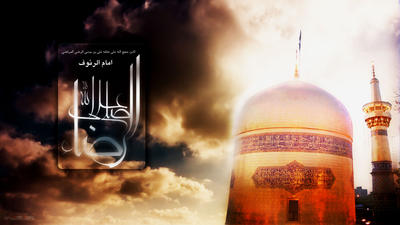
Imam Ali ar-Ridha (a.s.)


     NAME:                 Ali
     IMAMAT:             8th Imam from the silsila-e-Imamaat
     TITLE:                 Reza, Al-Raza, Badshah-e-Khorasan
     FATHER:             Imam Musa-e-Kazim (AS) - 7th Imam
     MOTHER:            Hazrat Bibi Najma (s.a.)
     BIRTH DATE:      11th Ziqaadah year 148 Hijrah Medina
     AGE:                   55 Years
     DIED ON:            17th Safar, 203 Hijrah
     DEATH PLACE:   Iran
     HOLY SHRINE:    Mashad – IRAN


BRIEF ABOUT IMAM ALI REZA (A.S.)

Ali al-Ridha's morality narrated by Shaykh Saduq
Ali al-Ridha is considered an infallible Imam according to Shia Islam. Below are some historical notes about him.
Shaykh Saduq narrates through the words of Ibrahim ibn Abbas that, "I never saw Ali al-Ridha committing excess over anyone in talking and interrupting anybody's speech before its coming to the end. He did not stretch his legs in the presence of others. When the meal table was laid he invited the servants to it, and took his meals with them. After taking rest in the nights he got up and made himself busy with the prayers to Allah. Similar to his fore fathers he carried food to the houses of the afflicted ones at the mid of nights."
Muhammad ibn Abi Ibad says about Ali al-Ridha, "He used mats of palm date leaves, straws and marsh reed in the summer season, and woolen carpets in the winter."
He led a simple life in his home, but when he went out he used to decorate himself and put on new and clean dress. He respected and honored the guests to the extent that one night a lamp of the house went out of order, the guest got to his feet to put it right. Ali al-Ridha made him sit and he set the lamp right, and said, "We do not employ our guests (exploit) upon work."
Yasir, the servant of Ali al-Ridha says, Ali Ridha said to us, "Whenever you are busy taking your meal, if I call you, do not get up till you have finished up eating." Another friend of Ali al-Ridha says, "One day a stranger came Ali al-Ridha's house and said, I am one of your friends and I am also not a poor man but my money has finished up and I do not have the expenses to return. You give me an amount and when I return to my city I will give it out as alms on your behalf." Ali al-Rida got up and went to another room, brought an amount of two hundred dirhams and gave it to him from behind the door and said, "Take this and go and it is not necessary to give it away as alms on my behalf."
They asked the Ali al-Ridha, "Why did you do it this way that he may not see you."
He said, "So that he does not catch my sight and get ashamed (embarrassed)."
Sulaiman, one of the friends of Ali al-Ridha says, "I went along with the Ali Ridha to the house. The labors were busy at work. There was a stranger among them whom the Ali al-Ridha did not recognize." He said, "Who is this man?" They said we have brought him from outside, so that he may help us. He said, "Have you concluded an agreement with him and fixed his wages?" They said, "No, he is a good man, whatever we pay him he accepts it and does not utter a word."
Ali al-Ridha was angry and annoyed and said, "I have always told you that when you employ someone for a job first of all fix his wages. Because, when his wages are fixed and you give more than that to him, he will become happy. But if you do not fix his wages and give him three times the amount, he thinks you have not given him the correct wages."

Imam Reza (Ali ibn Musa) was the son of the seventh Imam and according to well-known accounts was born in 148/765 and died in 203/817. The eight Imam reached the imamate, after the death of his father, through Divine Command and the decree of his forefathers. The period of his imamate coincided with the caliphate of Harun and then his sons Amin and Ma'mun. After the death of his father, Ma'mun fell into conflict with his brother Amin which led to bloody wars and finally the assassination of Amin, after which Ma'mun became caliph. Until that day the policy of the Abbasid caliphate toward the Shi'ites had been increasingly harsh and cruel. Every once in a while one of the supporters of Ali (alawis) would revolt, causing blood wars and rebellions which were of great difficulty and consequence for the caliphate.

The Shi'ites Imams would not cooperate with those who carried out these rebellions and would not interfere with their after. The Shi'ites of that day, who comprised a considerable population, continued to consider the Imams as their religious leaders to whom obedience was obligatory and believed in them as the real caliphs of the Holy Prophet. They considered the caliphate to be far from the sacred authority of their Imams, for the caliphate had come to seem more like the courts of the Persian kings and Roman emperors and was being run by a group of people more interested in worldly rule than in the strict application of religious principles. The continuation of such a situation was dangerous for the structure of the caliphate and was a serious threat to it.
Ma'mun thought of finding a new solution for these difficulties which the seventy-year old policy of his Abbasid predecessors had not been able to solve. To accomplish this end he chose the eighth Imam as his successor, hoping in this way to overcome two difficulties: first of all to prevent the descendants of the Prophet from rebelling against the government since they would be involved in the government themselves, and secondly, to cause the people to lose their spiritual belief and inner attachment to the Imams. This would be accomplished by having the Imams become engrossed in worldly matters and the politics of the caliphate itself, which had always been considered by the Shi'ites to be evil and impure. In this way their religious organization would crumble and they would no longer present any dangers to the caliphate. Obviously, after accomplishing these ends, the removal of the Imam would present no difficulties to the Abbasid.

 In order have this decision put into effect, Ma'mun asked the Imam to come to Marw from Medina. Once he had arrived there, Ma'mun offered him first the caliphate and then the succession to the caliphate. The Imam made his apologies and turned down the proposal, but he was finally induced to accept the successorship, with the condition that he would not interfere in governmental affairs or in the appointment or dismissal of government agents. This event occurred in 200/814. But soon Ma'mun realized that he had committed an error, for there was a rapid spread of Shi'ism a growth in the attachment of the populace to the Imam and an astounding reception given to the Imam by the people and even by the army and government agents. Ma'mun sought to find a remedy for this difficulty and had the Imam poisoned and martyred. After his death the Imam was buried in the city of Tus in Iran, which is now called Mashhad. Ma'mun displayed great interest in having works on the intellectual sciences translated into Arabic. He organized gatherings in which scholars of different religions and sects assembled and carried out scientific and scholarly debates. The eighth Imam also participated in these assemblies and joined in the discussions with scholars of other religions. Many of these debates are recorder in the collections of Shi'ites hadiths.

[Oyoun Akhbar Al-Ridha]

Wednesday, December 28, 2011

Salman Farsi talks with a Dead Person


Asbagh bin Nubata (r.a.) was a trusted companion of Ameerul Mumeneen Ali (AS). He went to see Salman Farsi (r.a.) who had settled in Madain. Asbagh (r.a.) says:

“I found him very sick, near his death. He told me: 'O Asbagh, the Messenger of Allah had informed me that, at the time of my death, a dead person would talk to me. Now, put me on a wooden plank and take me to the graveyard. On reaching the grave-yard, Salman faced towards Quibla and in a loud voice saluted the dead. Nobody replied. After saluting them several times without getting any reply, Salman said: “O Inhabitants of these graves, I am Salman, a slave of the Messenger of Allah. The Prophet had told me that at the time of my death a dead person would converse with me. Now, if that time has arrived, then, for the sake of Allah and His Messenger, please talk to me”.

Suddenly someone responded to his Salaam, and said: “O people who build and plant, and ultimately the buildings turn into ruins and gardens decay; ask me what you want,, I will reply”.

Salman (r.a.) asked: “Are you from the people of Paradise or of Hell?” The dead man said that he was from the people of Paradise.

Salman requested him to describe how he died and what agonies he had to undergo at that time. He replied:

“O Salman, please do not ask this. By Allah, if someone had snipped my flesh (by scissors) in little bits and removed the flesh from the bones, it would have been easier than the agony of death. O Salman, I always did good deeds in your world, always prayed on time, used to recite the Qur'an, was good to my parents, lived on lawful earnings. Then I fell ill and my life came to its end. At that time, a very tall person, with a frightening countenance, stood in the air before me. He pointed to my eyes and they lost their sight; to my ears and they became deaf; to my tongue and it lost its speech. I asked him who he was and why he was doing it to me. He said: I am the angel of death; your life has ended in this world. You have to go from here to another world'.

Then two persons came to me, one of them sat on my right, the other on the left. They informed me that they were the two angels who had written all my deeds in the worldly life. One, whose name was 'Raqueeb' gave my record of good deeds, on reading which I was much pleased. Then the other angel, whose name was 'Ateed', gave me the other record, a complete record of my sins; and on reading that I was very sad.

Then the Angel of Death came nearer and removed my soul through my nose, and I have not forgotten its agony yet. Seeing me dead, my relatives and family members started crying. The Angel of Death said: “Why are you crying? I have not done any injustice that you are complaining of. When his life came to end, I removed his soul on the command of Allah. And I will come to you so many times.”

Then another Angel took my soul and I was brought to heaven where I was asked about my deeds, viz. prayers, fasts, Zakat, Khums, Hajj, Jihad, recitation of the Qur'an, obedience to the parents etc. Likewise, I was asked whether I had murdered any one, or taken some one's property without any right, or been unjust to other people and such things.

Then that same Angel brought my soul back to earth. At that time the person who wanted to wash my body (Ghassal) removed my clothes and started the ritual washing (Ghusl). My soul cried out: “O servant of Allah, have mercy On this weak and broken body. By Allah, all its veins, whence I have come out, have been broken; and its limbs are like they have been minced”. My soul was imploring him in such a touching way that if the Ghassal were to hear it, he would have left washing the dead bodies altogether.
Then they covered me with Kafan (shroud), gave me Hunut,prayed upon me. When they laid me in the grave, I was so much frightened that words cannot describe it.

When they closed my grave, my soul entered my body again. An Angel, Munabbih (One who awakens, reminds) by name, came to me and made me sit. He ordered me to write down all the deeds which I had done in the world. I said that I did not remember. He said: 'I will go on reminding, you go on writing'. I said: 'Where is the paper?' He said: “This Kafan of yours will do for paper'. I said: 'Where can I find a pen?' He said: 'Your finger will be your pen'. I asked about the ink and was told that my saliva will work like ink.

When I had written all my deeds, the Angel put my writing around my neck like a band; it is as Allah says in the Qur'an:

“And the bird (i.e., deed done by one) of every man have We bound about his neck, and We shall produce unto him, on the Day of Resurrection, a book (in which his actions will be recorded) which he will find open, (it will be said to him) read thy book; thine own self will be a sufficient reckoner against thee.” (Qur'an, 17:13-14).

 (In other traditions, the name of the angel, who comes in the grave and guides in writing the deeds of the Mayyit, is given as”Ruman”)

Then an angel, very frightening, Munkar by name, came to me with a fiery club, and asked me: “Who is your Lord? Who are your Prophet and Imams? What is your religion?” I was so afraid that I became totally confused; my limbs were trembling; I could not understand what to reply. In that confusion, the Mercy of Allah supported me, and my heart became tranquil, and I replied; “Allah (His Power is Great) is my Lord; and Muhammad is my Prophet, and Ali bin Abi Talib is my Imam and Islam is my religion; and the Qur'an is my Book and the Kaaba is my Quibla”.

Then another Angel, who is called Nakir, interrogated me in the same manner about my beliefs. By Grace of Allah, I replied his questions also and said: “I bear witness that there is no god except Allah, and that Muhammad is His Messenger, and that Ali and his sinless progeny are the proofs of Allah, and that Paradise is Haqq (a Fact, Truth) and the Fire (of Hell) is true, and Sirat (Path) is true, and the Balance (of deeds) is true and the Questioning of Munkar and Nakir in the grave is true, and Resurrection is true, and raising (of dead) is true, and flying of the books (in which deeds of a person are recorded) is true, and that the Hour (Day of Judgement) is sure to come, there is no doubt in it, and that Allah will raise all the dead who are in the grave”.

Hearing these true answers, the angels said to me: “Sleep as a bride sleeps” (without any worry); they opened a door of Paradise towards my head, and the breeze of Paradise came to me, and my grave (which previously looked like a prison) become a vast place extending beyond my vision, and the whole place became a garden.

O Salman, a man must remember his Lord at all times, and must spend his life in His obedience, because death is a sure thing and every one will have to face all those things which I have told you.”

Asbagh (r.a.) said: “When the voice stopped, Salman (r.a.) told me to take him back home, there he lay on the ground and looking towards heavens prayed to Allah, and left this world.”


[Lawa'iju 'l-ahzan, vol. 1, (Lahore ed) pp. 367 – 370]

Friday, December 23, 2011

Incident of a bird who was covered by the blood of Imam Husain (a.s.)


After the martyrdom of Imam Husain (asws), a bird whose color was white landed on the dead body of Imam (asws). He covered his wings in the blood Imam Husain (asws) and went to a place where many birds were sat in the shade of trees and were talking about their food. Upon reaching their he said to the other birds, "Alas! You are talking about your food and the Grandson (asws) of RasoolAllah (saw) has been slaughtered on the plains of Karbala. His dead body is lying on the hot sands and His blood is still fresh.

When the other birds heard this news, they flew to Karbala and saw Imam Husain (asws) laid slaughtered while the accursed army of yazid (la) was taking His Holy Head towards Kufa. Imam (asws)'s dead body was lying there without ghusl or kaffan, and His sacred body had been trampled under the hooves of the horses. The hot sand of the desert was covering Imam (asws)'s dead body. The animals of the jungle and jinns were coming for the ziarat of Imam (asws). When the birds saw this great scene of oppression, they started crying loudly. All of the birds covered their wings with the Holy Blood of Imam (asws) and flew in different directions. They started telling people, "O' people, Imam Husain (asws) has been slaughtered in Karbala. Muslims have destroyed the whole Family of RasoolAllah (saw)."

Wherever these birds went, other birds would also gather around them. All would mourn Imam Husain (as). One of these birds came to Medina and went to the shrine of RasoolAllah (saw). He kept telling RasoolAllah (saw) about how Imam Husain (as) was slaughtered. When the other birds saw this bird, they gathered around him and all began mourning Imam Husain (asws). When the people of Medina saw this scene, they could not understand what had happened. They noted the day of the crying of these birds. Then after some time, the news of the martyrdom of Imam Husain (asws) came to Medina , then they realized Imam Husain (asws) had been martyred on the same day they had seen these birds gathered at the shrine of RasoolAllah (saw) offering their condolences.

One bird flew from the shrine of RasoolAllah (saw) and landed in the garden of a Jew. He sat upon a tree and cried over Imam Husain (asws) the entire night. The owner of this garden had a daughter who was blind and disabled. The Jew would bring his daughter in the day and bring her back into the home during the evening. That day however the Jew was very busy and could not take his daughter back to the home. So the girl spent the whole night under the tree in which the bird was sat mourning over Imam Husain (asws).

A drop of Imam Husain (asws)'s holy blood fell from his wings onto one eye of that blind girl. With the blessing of the blood of Imam Husain (asws), her sight was immediately restored. Then another drop of the blood of Imam Husain (asws) fell onto her other eye and sight in that eye was also immediately restored. Then a few drops fell on her body. With the blessing of the Holy Blood of Imam Husain (asws), all of her disabilities were healed.

In the morning, when the father came in the garden, he saw a healthy girl walking in the garden. He asked her "Do you know where my sick and blind daughter has gone?"

The daughter replied, "O'my father, I think you do not recognize me. I am your sick and disabled daughter."

Upon hearing this, the Jew fell unconscious. When he came to, he asked his daughter how she had been cured. The daughter took hold of the hand of her father and brought him to the tree upon which the bird was sitting and mourning Imam Husain (as). The daughter said, "O'my father, in the night when I was lying under this tree. A few drops of blood fell down from the wings of this bird and with the blessing of that blood I was cured." That Jew said to the bird, "O'bird, for the sake of the one who created you, speak to me in my language." Allah blessed this bird with the ability to speak in the human language.

The bird said, "I was sitting with my fellow birds when suddenly another bird came and said, "O' birds, you are busy in gossips here while Imam Husain (as) has been slaughtered in Karbala. The oppressors have beheaded Him and His whole Family has been destroyed. Upon hearing this, we immediately went to the desert of Karbala where we saw the dead body of Imam Husain (as) laying on the plains of Karbala with His Holy Blood still freshly flowing. We covered our wings with His Holy Blood and flew in different directions. I came here to offer my condolences to RasoolAllah (saw)."

When the Jew heard this, he said, "No doubt the religion of the Grandfather of Imam Husain (as) is the true religion. If there is this much great blessing contained in a few drops of His Holy Blood, then what would be the status of such personality."

The Jew embraced Islam immediately along with 500 people from his tribe.

[Mantaqib Tareehi page no 107-109]

Twitter Delicious Facebook Digg Stumbleupon Favorites More

 
Design by Team110 | Visit Sipah-e-Mahdi(a.t.f.s.) - Visit Ali Maulah | Nohay Lyrics